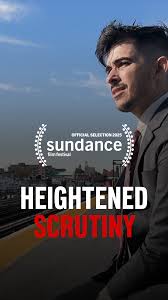
I finally saw Heightened Scrutiny yesterday. The documentary’s title comes from its subject(s). The film covers the lead up to U.S. v. Skrmetti (2025) following the ACLU’s lead lawyer on the case, Chase Strangio, as he prepared for the argument. Though the film does not dwell at length on the legal arguments the title refers to the central claim against bans on gender affirming care bans such as Tennessee’s. Heightened scrutiny refers to the standard the government must meet in equal protection cases in which a law or policy affects a group of persons. Heightened scrutiny–strict scrutiny or intermediate scrutiny–is applied when the government is utilizing a suspect classification (race, religion, national origin, alienage) or is utilizing sex/gender. The government must provide a compelling governmental interest and show the policy is narrowly tailored to achieve that interest a test Justice O’Connor negatively described as “strict in theory but fatal in fact,” a standard used to strike down differential treatment such as racial segregation and later, thanks to the work of Pauli Murray and RBG, sex-based discrimination in a variety of instances.
The question of heightened scrutiny is raised in cases involving restrictions on transgender persons because in 2020 in the case Bostock v. Clayton County–a Title VII (workplace discrimination prohibitions in the Civil Rights Act) case rather than an equal protection case–the majority argued that discrimination on the basis of sexual orientation or gender identity (ie, against LGBTQ persons) requires sex-based discrimination, imposing different rules based on sex assigned at birth and sex-based stereotypes. You can’t fire a gay man, for example, for being gay if you would not fire a woman who was attracted to men. You can’t discriminate against a trans person without determining their identity is inappropriate based on their sex assigned at birth, ie, for behaviors you would accept from someone whose gender identity aligned with their sex assigned at birth. Skrmetti should have been a slam-dunk here. The treatments being banned are allowed for conditions other than gender dysphoria, such as puberty blockers for treating precocious puberty or hormonal treatments to manage endocrine disorders. But the court determined that the law did not discriminate on the basis of sex or on transgender status but on age and medical condition and therefore rational basis and not heightened scrutiny apply.
The technical, legal language here obscures the lived experiences and actual practices being discussed. This is not accidental, foregrounding how decisions of the court affect actual people can create a sense of empathy for litigants who experience the violence of the law. We see this play out in the pair of cases coming out of the state of Colorado in which the court was asked to allow religious exemptions to anti-discrimination law, permitting individuals to refuse services for same-sex weddings (a cake baker and a website designer). In Masterpiece Cakeshop, the business owner was pitted against a gay couple who could discuss the dignitary harm of being told they could not purchase a cake from the shop. Hearing the men narrate their experience invited empathy. It would suck to be told you cannot purchase a mundane service because of who you are. In the website design case, however, there was no actual instance of a denial of service. In fact, it appears the ADF may have manufactured a false request in order to allow the web designer to have standing based on actual harm (generally challenging a law based on a hypothetical harm is not allowed). Consequently the web designer was able to present her case without the court or the public able to put a face to the harm on the other side. Clever lawyers.
Heightened Scrutiny tries to put a face to these cases, difficult when the litigants are vulnerable both by virtue of being trans and because they are literal, actual children. They foreground the case of Mila, a young girl in Queens who speaks out against an anti-trans policy in her school (which happens to be where Strangio’s child attends) and who spoke at the rally outside the court on the day Skrmetti was argued. I did not recognize Mila until they showed her rally speech. She was very brave to follow a bunch of adults and to make her case with a hostile crowd on the other side of the barricades, not to mention the media attention and cameras. I remember her not only because she was so young and tugged at the heartstrings because she was clearly a little nervous but because as soon as she started speaking her younger brother wrapped his arms around her as if to say “I’m here with you.” That’s family.
The film’s title also refers to the generalized heightened scrutiny for all trans people in the last five plus years, accelerating since 2021. The film highlights this by showing how in 2021 no states had anti-trans legislation but by 2024 almost half of all states banned gender affirming care for minors(as well as having other limitations on trans life.) Over a decade trans people have gone from a curiosity to being public enemy number one not just for conservatives seeking a restoration of traditional gender roles and heteronormativity but for reactionary centrists, the moderates who range from “just asking questions” to scapegoating trans people for Democratic losses. The film illustrates this focusing primarily on the New York Times and their coverage that persistently portrays the “transgender issue” as being a question of whether trans activism has gone too far too fast and not being a question of whether society is doing right by their trans community members. They also feature the infamous 2018 Atlantic cover showing a transmasculine young person (who was 22 at the time and had no idea what the story was going to be about) with a headline “your child says they are trans and want medical treatment. They’re 14.” The other two cover stories–the health costs of racism and the potential for a pandemic–seem comically more significant if representing more abstract fears for the white, upwardly mobile, highly educated readers of The Atlantic. Bummer that your kid is getting stopped and frisked or that you don’t have health insurance in case of disaster but I might have to explain why my kid is going by a different name to my social circle. Trans skepticism has been a handy way for mainstream media to signal its thoughtful, rational approach that weighs evidence and does not get carried away by activists. The institutional turn against DEI (ie, inclusion) demonstrates that trans people were always the canary in the coal mine. Those in positions of power and privilege only made gestures toward equality and inclusion out of social pressure, they never genuinely believed in sharing their resources.
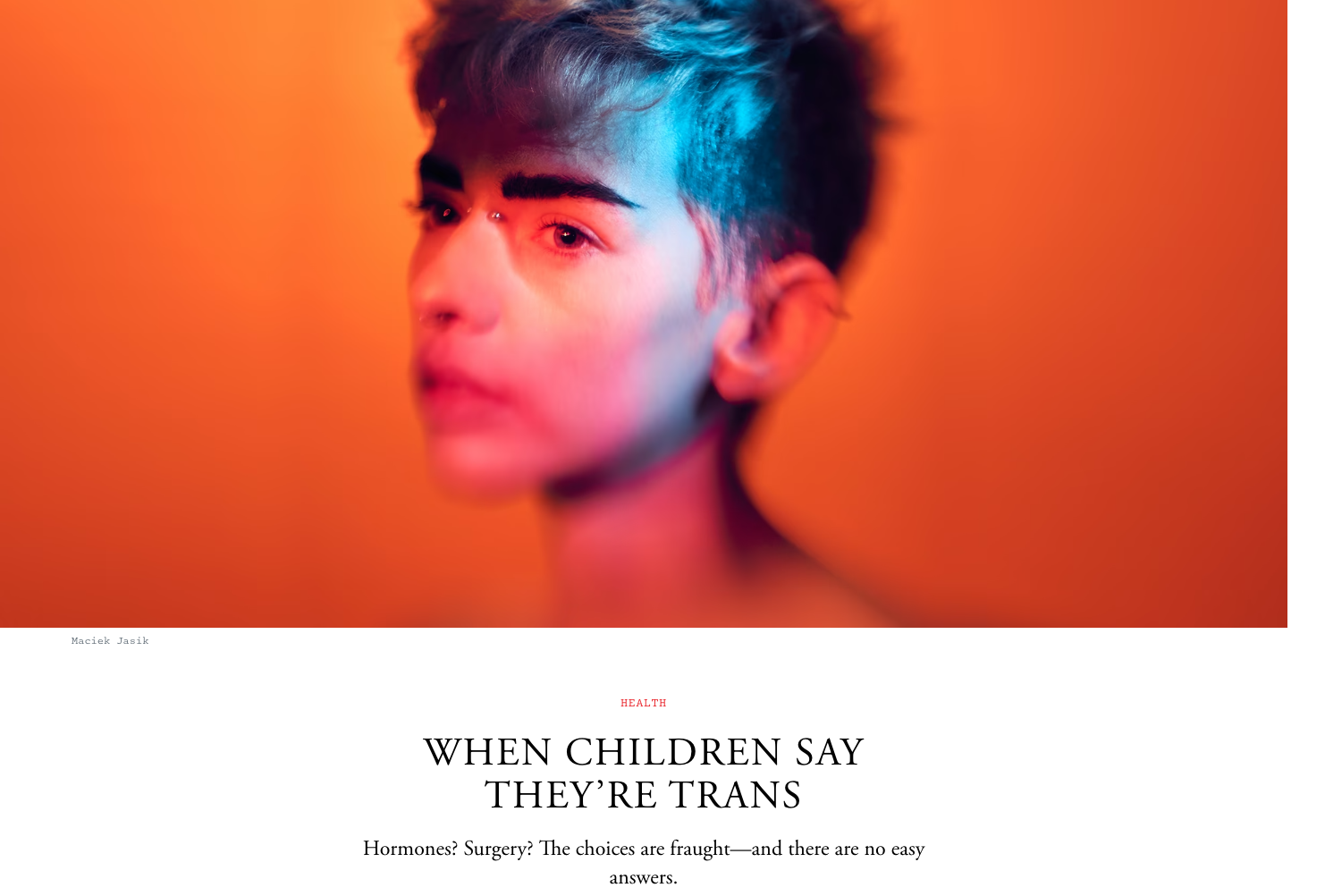
The heightened scrutiny of trans issues is fatal in fact, allowing conservatives and judges alike to cite “even the liberal New York Times.” Trans and non-trans journalists, media critics, and activist groups have noted the bias evident in the coverage in open letters to the paper. More recently a former editor has claimed the tenor of the coverage reflects the position of the paper’s owners. Shout out to Trans News Network, an independent, trans-helmed media site, for their exclusive interview with Billie Jean Sweeney on the behind the scenes decisions the paper took and the consequences. Other critics of the coverage have noted the paper’s failure to include trans voices as writers or sources in many of their articles, allowing claims about trans people but not by them.
The beating heart of the film, however, and the subject of heightened scrutiny is Strangio. I have very complicated feelings about putting a single individual under a microscope (he voices this as well) that I need to sort out so this discussion is to be continued.
 transgender for everyone
Leave a comment