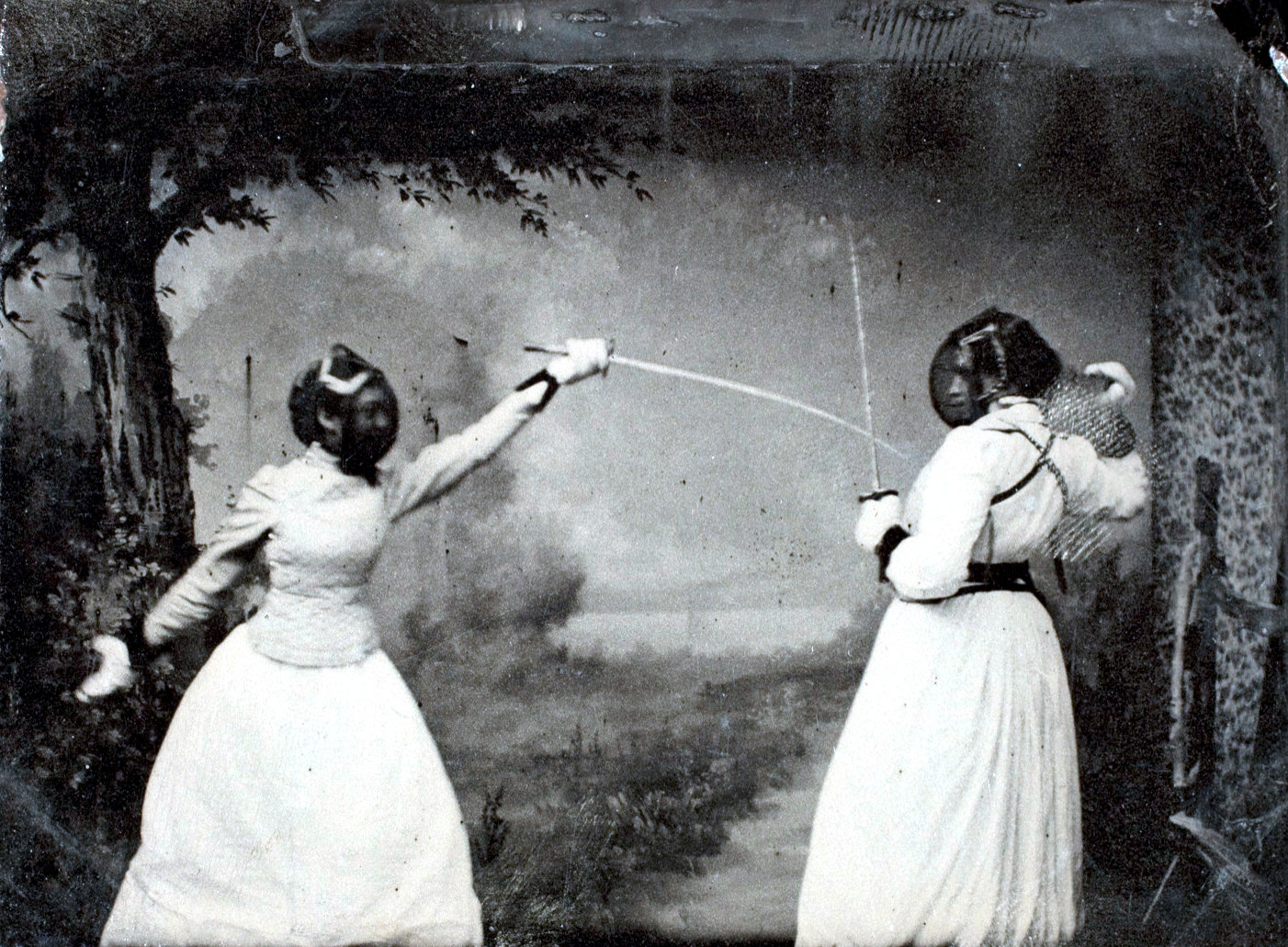
(Neither of these figures are Judith Butler or the Gender Spiral hosts. I just like this picture.)
I occasionally listen to Gender Spiral, hosted by two grad students (?) interested in, well, gender. It makes them (all of us) spiral. I don’t listen to every episode but was definitely interested in the Judy! episode. I tend to recall ephemera about various theorists, especially those that illuminate something about their thinking. In the case of Butler it is that in the 90s a fan of Butler wrote a ‘zine called Judy! That (correctly) sounds like the most 90s sentence ever constructed. I had a deep affinity to the hosts’ confession of overwhelm at the opportunity to interview Butler. They have–quite improbably– become one of the most widely known theorists in spite of their notoriously impenetrable writing. As it turns out, underneath the Hegelian, Lacanian, psychoanalytic, poststructuralist jargon was a surprisingly accurate premonition about the importance of the complex and unstable relationships between gender, sex, power, and subjectivity. And in the wake of real world gender trouble, Butler is now forced to reflect on the right wing reactionary backlash to the present future of gender.
I have a complicated relationship to Butler. As an undergrad I did not want to do/be associated with feminist theory, an unarticulated idea until my mentor in Philosophy (who was fantastic!) helped me identify graduate programs to which I should apply and who observed an apparent dislike when he suggested one program because of two feminist theorists working there. (Spoiler: I am now a feminist theorist.) I have zero explanation for this. I would have described my politics at the time correctly as feminist. But I did not want my precious intellectual project associated with feminism (my mentor in philosophy would describe himself as a feminist philosopher and he taught feminist philosophy so this attitude did not arise from him). Internalized misogyny? The consequence of reading a lot of dead white men and so associating the life of the mind with masculinity? Probably. Theory being the place where I could explore Other Possibilities with Regard to my Fucking Body? Absolutely.
Nevertheless I plunged into feminist theory as a graduate student including Butler who, I now realize, I read in almost all my theory classes. They were The Thing at the time, around the publication of Bodies That Matter. I prodded Butler carefully, not fully understanding their argument but being rather intrigued. They were my first exposure to psychoanalytic thinking and to Hegel and so probably provided ample evidence feminist theory was the Real Deal.
So. I am not totally proud of the fact I also wrote a paper for a (non-feminist) theory course in which I critiqued Butler’s writing. Not in the same vein as Martha Nussbaum’s “The Professor of Parody.” Nussbaum defended the turf of Philosophy as the field which provides clarity of thought rather than hiding mundane ideas in a sea of obfuscating text. Nussbaum further accused Butler of political quietism, making the claim that Butler’s thought did not lend itself to an actual feminist politics beyond radical ideas, an accusation Nussbaum calls “hip defeatism” that fairly accurately captures a general critique of postmodern/post-structuralist thought.*
Nussbaum’s critiques are generally fair, if relying on an uncharitable reading of Butler. However, dear reader, I criticized Butler for not being obfuscating enough. I argued through two authors I suggested did a much better job at obfuscation–Nietzsche and Derrida. No joke.** I like(d) the whole idea of taking that which is Common Sense–like the gender binary–and making it appear strange. I love Nietzsche’s metaphor of rumination, to consume a text and barf it back up to chew on it again, like cows. I was in love with Derrida’s The Postcard (which I read as a sophomore in college, thank you Philosophy Mentor) and his analysis of the image of Plato directing Socrates to write (it’s a whole reversal of roles as it mistakenly suggests the pupil (Plato) is the teacher, it has them writing they defended the immediacy of speech), and also Plato might be sodomizing Socrates (another top/bottom reversal going on). And I enjoyed that Derrida had a whole riff on this possible mis-translation and on a marginal comment in Nietzsche’s work that may or may not be a random note to himself–I have forgotten my umbrella.
I still find Butler’s prose often unnecessarily difficult and in a way that is not always useful for the political project of imagining gender differently. I often show students a 10-ish minute clip of Butler explaining performativity and have had students comment on the clarity and simplicity of their oral explanation versus the written (Derrida nods approvingly–and that’s the problem!) More recently Butler has given some pithy reflections on their work and the rise of “gender ideology.” I think that the intuitive sense students have that Butler is describing something they understand about gender might be the way that Butler’s ideas have quietly become much closer to common sense than in the 90s. They have an intuitive sense of the performative nature of gender and are more savvy about the ways heteronormativity shapes gender. This intuitive sense, however, can be difficult in getting students to recognize “what rests on the unthought stability of natal sex,” that is, they struggle to see just how serious people are about pushing back against queer and trans life because of how destabilizing these challenges are and how many social systems rest on the stability of sex.
I had several “Famous Theorists: they’re just like us” moments while listening:
- The statement: “I definitely don’t know what gender I am when I am swimming.” I do open water swimming during the warmer seasons and I have always related to Kurt Vonnegut’s (paraphrased) quote that he is a disgrace on land but beautiful in the water. The submerged body, moving through and with water, is my gender. No boundaries, just waves.
- Butler describes somatizing discomfort, or managing the general anxiety of the world through the body in their case with yoga and swimming. I would add running and picking up and putting down heavy stuff but–yes. Less thinking, more moving.
- The description of the gender trouble project as thinking through “what rests on the unthought stability of natal sex”–how our sense of our self/identity as relational–what we mean in family, society, relationships is contingent on the stability of “sex” as a meaningful category by which we orient ourselves. If these relationships are contingent so is our identity and our future possibilities are not determined by the declaration “It’s a boy/girl.” Now what?
*A note: Nussbaum’s article was published in 1999 but the accompanying photo is from Butler’s 2017 trip to Brazil that they discuss in 2024’s Who’s Afraid of Gender? (as well as in numerous articles and interviews since, I would imagine, being called a pedophile and being physically accosted does probably leave a mark on someone).
**Pun intended. BTW my entire argument was around the idea of “no pun intended,” or the possibility to surprise ourselves with our own use of language.
 transgender for everyone
Leave a comment