Everything is transgender. This thread on Mumsnet, titled “NHS removes ‘sex’ discriminator from their bmi calculator” more or less captures the problem with gender critical feminism. Or, to be fair, a problem with this variety of gender critical feminism that relies upon, to borrow from Eve Kosovsky Sedgwick, a paranoid reading. The OP correctly notes that the NHS BMI calculator asks the visitor to input information including height, weight, and race, but does not ask about sex.
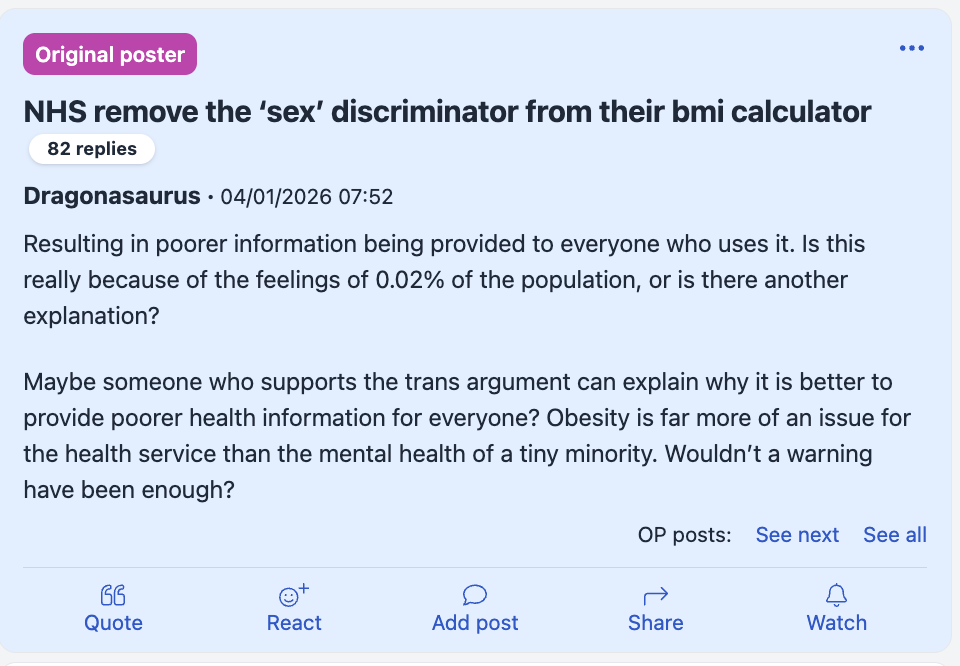
The immediate presumption is that the reason is because trans and that the exclusion of sex from the calculator will make it less accurate, leaping to conclusions here about both cause and effect. The supposed corruption of data is often used as one of the many harms of “gender ideology,” working from a presumption that the category of sex is objective and has consequential, measurable material effects. In other words, sex is an ontological fact. As it turns out, BMI is a fantastic example of how and why we should always pay attention to how data are constructed and the work done by measurement and categorization to produce ways of seeing the world that are not simply 1:1 representations of a real, material world.
The problem, as someone in the thread notes, is that BMI does not use and has never used sex in calculating BMI which is, simply, a ratio of height to weight. The paranoid reading immediately rejects this fact and makes an anticipatory claim, assuming facts not in evidence:
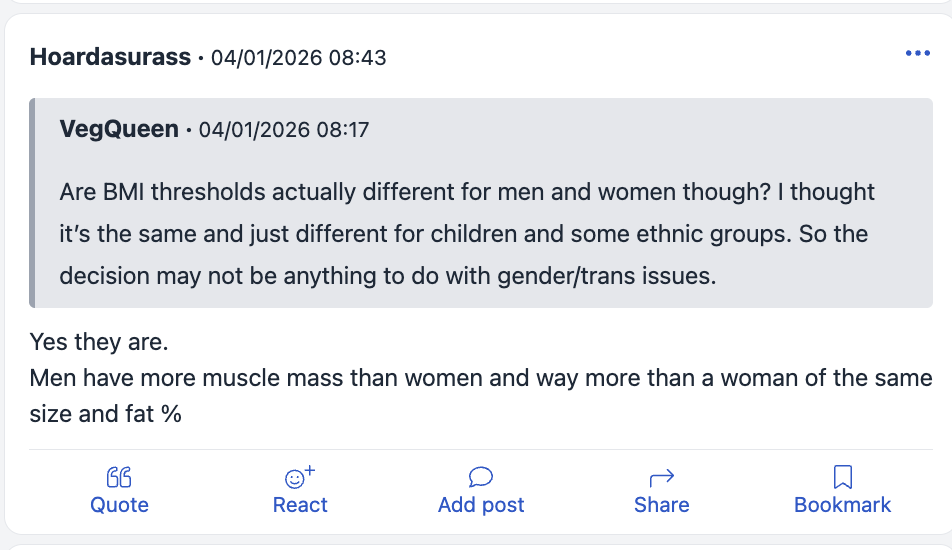
And then, of course, the assumption is that the removal of sex (which has never been included in the calculation) is an anti-science step back “further than medieval” that is attributable to the queer community:

Various posters weigh in (no pun intended) on the factual claims, some noting that the change is not recent and others observing that most BMI calculators do not ask this information since it is irrelevant to the data produced and, the NHS says, it was only used in tailoring recommendations based on BMI. This thread exemplifies why the information should not be asked; it gives a false impression that this data is utilized in calculating BMI. If they ask you to input sex the presumption is that information is relevant for the output you receive. The posters have a preconceived notion that sex matters and therefore the information should be collected and that the information should be collected because sex matters, a classic case of begging the question.
Further in the thread some posters land on a deeper critique of BMI more generally as a tool but their paranoid reading does not not allow this information the change their position that sex must be recorded and that the failure to do so is evidence of sinister motives. As a poster correctly noted, BMI is simply a ratio of height to weight plugged into actuarial tables based on 19th century Belgian men by a mathematician who was looking for population-level patterns. And, yes, this does reflect a general pattern of generalizing “human” from “men” which we can agree is a problem, particularly when BMI is used to make general claims beyond “this is how you compare to averages among this very limited data set.”
The data were never meant to apply to individual level variations or to diagnose which is why much of the thread notes all the problems with the measure from not accounting for muscle mass and composition, failing to account for variations by age (NHS does differentiate between children and adults but not different adult categories even though body composition shifts in individuals over time), and racial/ethnic patterns of body composition that may be different than the comparator population. One poster in the thread includes a link to a critique of BMI that describes the history of the measurement and the fact that the primary reason for its continued use in spite of all these critiques is not its demonstrated utility in measuring health but simply that it is easy data to gather and produce and it appears to provide actionable information. Two measurements are taken that produce a number that places you on a chart with a quick label–underweight, healthy weight, overweight, obese–meant to guide advice for patients. Even though BMI is an incredibly flawed measure it is often used as shorthand for health and, in the worst cases, is used to make medical decisions like eligibility for certain procedures. Someone in the thread includes a link to an article about the NHS denying surgery based on a high BMI and in the U.S. insurance companies and providers often use it to calculate eligibility for certain kinds of care. This is, certainly, a problem but not one that gathering sex-based data would change at all. The NHS could ask for all sorts of objective data about the patient–shoe size, waist circumference, age, hair color–that would be exactly as meaningful in the actual calculations.
The thread notes many of the different individual level variables that might matter including muscle mass, body fat, pregnancy, etc., all of which are true. The general presumption, however, is that sex matters and that those differences can be generalized even though, for example, one person observes that women often weigh more after pregnancy (though that would imply they should gather data on pregnancy?), breasts contain fat, weight carried around the midsection has a different effect than weight carried elsewhere, etc. All of this suggests there are individual-level variations within sex categories that may be as important as differences between them but they assume they can generalize from sex categories. Scientific evidence points to wide variations in body composition even within an individual’s lifespan. We know, for example, that muscle mass tends to decline with age. Hormones matter–testosterone is linked with higher muscle mass but testosterone levels vary across our lifespan (yes in men, women, and non-binary people). The amount of breast tissue varies widely in the population within sex categories. In other words BMI is an objective measure–a ratio between two observable facts about a body–but what that measure tells you, especially at the individual level, is indeterminate. If only there was some lesson to be learned from this.
 transgender for everyone
Leave a comment